CEMS for Cement Plants
Continuous emission monitoring system (CEMS) for cement kilns and related non-metallic sources, combining extractive and in-situ gas analysers with a particulate in-situ analyser to measure SO2, NO2 and total PM/dust against DOE emission limits.
Overview
About the CEMS for Cement Plants.
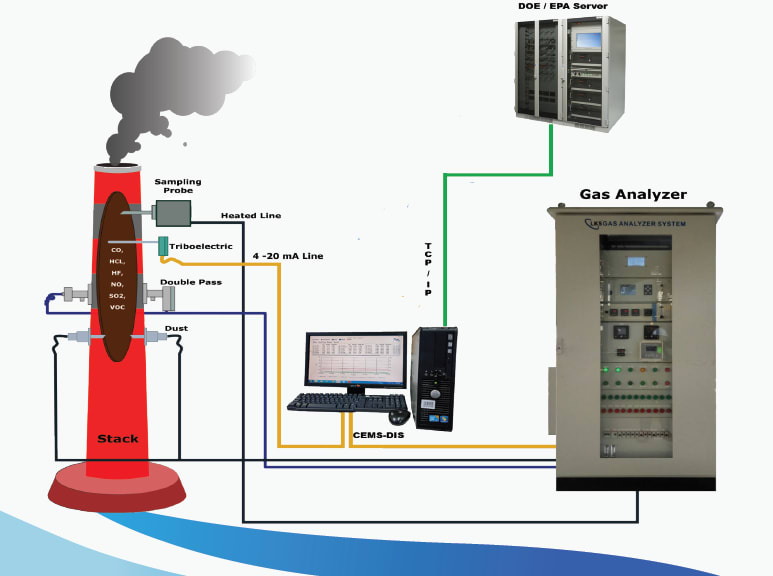
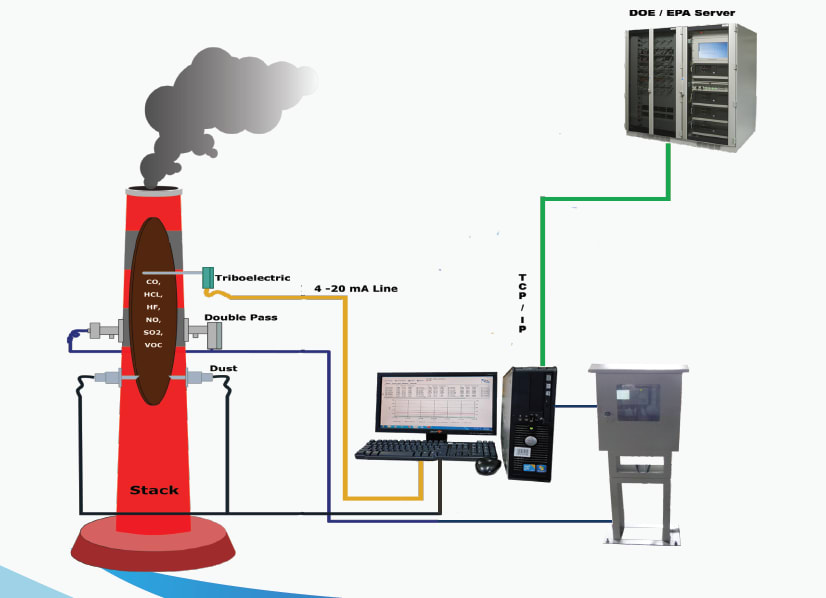
This continuous emission monitoring system (CEMS) for cement plants measures sulphur dioxide (SO2), nitrogen dioxide (NO2) and total particulate matter (PM) in stack gas. It is built from extractive gas analysers, in-situ gas analysers and a particulate in-situ analyser, selected to suit the source. Results are collected by a data acquisition system (DAS) and passed through a data interface system (DIS) to the DOE / EPA server, so emissions can be checked continuously against the limit values that apply to cement kilns, glass furnaces, rotary furnaces and ceramic furnaces.
Features
- One system covering SO2, NO2 and total PM / dust
- Extractive and in-situ gas analysers, plus a particulate in-situ analyser
- Data acquisition system (DAS) and data interface system (DIS) for reporting
- Sized for cement kilns of all sizes, glass furnaces (≥ 1 ton/day), rotary furnaces (≥ 1 ton/day) and ceramic furnaces (> 10 ton/day)
How it works
- SO2, extractive: NDIR, NDUV, GFC, FTIR, PAS or fluorescence
- SO2, in-situ: DOAS, GFC or FTIR
- NO2, extractive: NDUV, PAS or fluorescence
- NO2, in-situ: DOAS
- Total PM / dust, extractive: light scatter or beta absorption
- Total PM / dust, in-situ: transmissometry or triboelectric, double pass or single pass
Emission limit values
- Cement kiln (all sizes): NO2 800 mg/m³, total PM 50 mg/m³
- Glass furnaces: SO2 800 mg/m³, NO2 800 mg/m³, total PM 50 mg/m³
- Rotary furnaces for hard quicklime or sintering dolomite: NO2 1500 mg/m³, total PM 50 mg/m³
- Ceramic furnaces: total PM 50 mg/m³ where the dust load emitted is ≥ 2.0 kg/hour
DOE / EPA requirements
- Supplier listed as an appointed and approved company on the DOE / EPA website
- TUV / MCERT certificate
- Data acquisition system (DAS) and data interface system (DIS)
Applications
- Cement kilns
- Glass furnaces, including glass fibre
- Rotary furnaces for quicklime and dolomite
- Ceramic furnaces for tiles, bricks, refractories, stoneware and porcelain
LKS supplies CEMS for cement plants in Malaysia, with installation, calibration and after-sales support. Contact our engineers to scope a system for your stack.
Specifications
| Analyser types | Extractive gas analysers; in-situ gas analyser; particulate in-situ analyser |
|---|---|
| Measured parameters | SO2, NO2, total PM / dust |
| SO2 principles | Extractive: NDIR, NDUV, GFC, FTIR, PAS, fluorescence; in-situ: DOAS, GFC, FTIR |
| NO2 principles | Extractive: NDUV, PAS, fluorescence; in-situ: DOAS |
| Total PM / dust principles | Extractive: light scatter, beta absorption; in-situ: transmissometry / triboelectric, double pass, single pass |
| Data systems | Data acquisition system (DAS); data interface system (DIS) |
| Sources covered | Cement kilns (all sizes); glass furnaces (≥ 1 ton/day); rotary furnaces (≥ 1 ton/day); ceramic furnaces (> 10 ton/day) |
Lifecycle support
Installed, calibrated and maintained.
With more than two decades in valves and instrumentation across a diverse range of industries, we keep instruments accurate and valves healthy, because valve health management is vital for plant safety.
- Installation & commissioning
- Calibration & testing
- Maintenance & overhaul
- Dismantling & replacement
Related products
- Full SystemCEMS for Iron and Steel Mills (Ferrous Metals)View details
- Full SystemCEMS for Iron and Steel Mills (Non-Ferrous Metals)View details
- Full SystemCEMS for Non-Metallic IndustriesView details
- Full SystemCEMS for Oil and Gas RefineriesView details
 Full SystemCEMS for Palm Oil MillsView details
- Full SystemCEMS for Power PlantsView details
- Full SystemCEMS for Rice MillsView details
- Full SystemCEMS for Saw MillsView details
Get in touch
Need a quote or technical advice?
Tell us about your application and our engineers will recommend the right instrument or system.
- 01Share your applicationProcess, medium, range and site conditions.
- 02Engineer recommendationWe match the right instrument or system to your process.
- 03Quotation and supportSupply, installation, calibration and after-sales service.