On this page
- What conductivity tells you, and what it does not
- How contacting and inductive sensors measure conductivity
- When an inductive conductivity sensor is worth considering
- When a contacting sensor may be the better fit
- Check chemistry, temperature compensation and installation
- A practical conductivity sensor selection checklist
- Frequently asked questions
Key takeaways
- Choose the measurement principle against the fluid and process conditions, not the industry label.
- Inductive designs avoid direct-contact electrodes, but still need inspection and cleaning planning.
- Match a contacting sensor's cell constant to the expected conductivity range.
- Check chemical compatibility, operating pressure, temperature and installation against the specific sensor configuration.
- Record the temperature compensation method and whether values are reported at process temperature or normalised.
An inductive conductivity sensor is worth considering when a process liquid is concentrated, chemically aggressive or prone to fouling, and direct-contact electrodes may be a concern. It measures through an electrodeless arrangement, but the sensor still needs to suit the liquid, operating conditions and required measurement range.
A contacting conductivity sensor may be a better fit when its electrode design and cell constant match the application, including low-conductivity water. Start with the measurement objective and process conditions. Then check temperature compensation, installation and how the sensor can be inspected or cleaned.
What conductivity tells you, and what it does not
In an aqueous solution, conductivity reflects the movement of dissolved ions. It is a combined response from the ions present, not an identification of each individual chemical or a direct measurement of one specific substance. The USGS measurement guidance describes specific conductance as an indirect measure of the collective concentration of dissolved ions.
That makes conductivity useful for monitoring change. A rising or falling reading may indicate that the ionic content of a process stream has changed. This can help with water treatment, rinsing, chemical preparation or process control. Conductivity alone cannot tell an operator which ion caused the change, though. If the process requires a specific chemical concentration, check that the sensor and measurement method are intended for that solution. Some sensors provide concentration ranges for specified solutions, but that does not make conductivity a universal chemical analysis.
Before comparing readings, agree on the measurement basis. A value may be reported at process temperature or normalised to a reference temperature. State which basis is used in displays, trends and handover records. Otherwise, readings on different temperature bases may appear to show a process change when the difference is due to temperature.
How contacting and inductive sensors measure conductivity
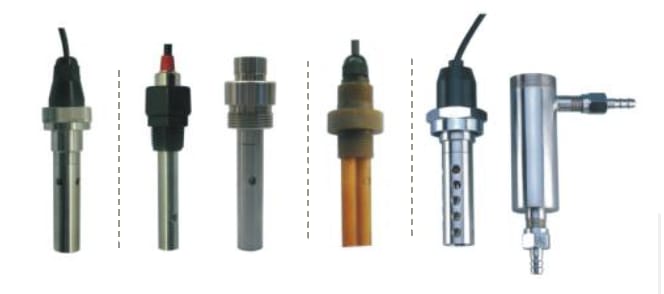
A contacting conductivity sensor has electrodes in direct contact with the liquid. In the industrial sensor range from LKS Group, an AC voltage is applied between the outer electrodes, producing an ionic current in the solution. The instrument uses that response to determine conductivity. For an electrode cell, the cell constant relates electrode spacing to electrode area and is used with conductance to calculate conductivity.
The cell constant is an important selection check. A low-conductivity solution produces a weaker signal, so closely spaced electrodes and a lower cell constant can help. Higher-conductivity solutions need a different arrangement, often with a higher cell constant. Because the electrode surfaces are exposed to the process, consider deposits, contamination and changes to electrode condition when planning inspection and maintenance.
An inductive design uses a driver coil and a receiver coil instead of electrodes that directly measure current at the liquid interface. The driver coil induces a current in the liquid. Ions carry that current, and the resulting signal induces a response in the receiver coil. The instrument relates that response to conductivity. The sensing arrangement is electrodeless, although the sensor body and sensing region still need to be exposed to the process correctly.
The practical distinction is not simply that one sensor touches the liquid and the other does not. Both depend on the liquid's ionic conductivity. They differ in how the instrument couples to it and which process risks the design may help address. A guide to online water-quality monitoring and instrumentation can help place conductivity alongside the other measurements needed to understand a water process.
When an inductive conductivity sensor is worth considering
Consider an inductive conductivity sensor when the process is concentrated, chemically aggressive or likely to foul the exposed sensing area of a contacting cell. The WSEC1001 electrodeless inductive conductivity sensor is one example. Its driver coil induces current in the solution and its receiver coil measures the resulting signal. LKS describes it for harsh chemical media, concentrated acids and salt solutions, and highly polluted environments.
The electrodeless arrangement avoids direct-contact electrodes. LKS describes the WSEC1001 as eliminating polarisation and clogging errors and resisting fouling. These product features are reasons to consider the design, not grounds to assume that it needs no attention. Dirt or deposits may still collect on exposed surfaces or around the sensing opening. Include access for inspection and cleaning in the design review, and consider whether a coating or deposit could affect the measurement.
Check the catalogue range against the real process, including start-up, normal and upset conditions. The WSEC1001 product information lists conductivity ranges up to 2000 mS and concentration ranges for specified acids and alkalis: 0–10% HCl or NaOH, 0–15% HNO3 and 0–30% H2SO4. These are stated ranges for specified solutions, not proof of suitability for every mixture or operating condition. Confirm the proposed range and application against the relevant product information.
The product page lists a PP body, a maximum pressure of 1.6 MPa, and flow-through, pipeline and immersion installation options. Its overview lists a 4–20 mA output. Treat these as catalogue details to check against the actual service, not as a general compatibility guarantee. Verify the body's chemical compatibility, operating limits and required installation arrangement before selection.
Also ask what the reading needs to do. An inductive arrangement may be justified when contact electrodes present a clear process or maintenance concern. If the purpose is to track a water-quality trend and the liquid is suitable for a contacting cell, an electrodeless design may add no practical benefit. For water, wastewater and process-industry applications, make the decision from the liquid and installation details rather than the industry label alone.
When a contacting sensor may be the better fit
A contacting conductivity sensor can be a straightforward choice when its electrode materials, cell constant and installation suit the process. LKS Group's industrial conductivity sensors are offered with cell constants from K=0.01 to K=30. The product page lists a measurement range from 0–20 µS/cm up to 30–600 mS/cm across the series. It describes lower cell constants for low-concentration solutions and higher cell constants for higher-conductivity solutions.
That range of configurations matters because one electrode geometry does not suit every conductivity level. The series lists five cell constants: K=0.01, K=0.1, K=1.0, K=10.0 and K=30.0. Its listed applications include pure and ultra-pure water plants, thermal power plant water treatment, sewage treatment and seawater purification. Use these catalogue examples as a starting point, then match the required range and sensor configuration to the specific stream and measurement objective.
Check the process-contact materials and sensor form as well. The product information describes electrode options including stainless steel, titanium alloy and platinum, and compression-type and pipe thread-type versions. It lists a double-cylinder titanium alloy structure and a large-area platinum structure for some higher cell constants. These are product details, not a general guarantee of compatibility with every chemical. Confirm the proposed configuration and whether its wetted materials suit the fluid.
Neither principle is universally superior. A contacting sensor may be preferable where a suitable cell constant covers the expected range and the electrode design is compatible with the fluid. An inductive sensor may be worth evaluating where direct-contact electrode concerns are more significant. For low-conductivity water, pay particular attention to cell constant, installation and the expected signal. An electrodeless design is not automatically the better option.
Check chemistry, temperature compensation and installation
Start with the process description. Record the fluid composition as far as it is known, including changes between normal operation and cleaning or upset conditions. Include pH, operating temperature, pressure and the expected conductivity range. Note whether the liquid contains suspended material or is likely to leave deposits. These details inform material selection, measurement range and the practicality of inspection or cleaning.
Temperature compensation needs its own review. Conductivity changes with temperature, and the relationship depends on the ionic species present. A standard compensation approach is not necessarily suitable for every solution. The USGS notes that standard temperature compensation can cause substantial errors in low-pH water. That guidance concerns water measurement, so do not assume it directly describes every concentrated industrial liquid. The US EPA discussion of ionic strength also describes the roles of temperature, ionic strength and ion mobility in conductivity.
Ask how the instrument handles temperature. Does it measure temperature? Does it apply compensation? Does it report a compensated value or a value at process temperature? The contacting sensor product page lists a built-in temperature sensor and real-time temperature compensation, with the compensation element specified by the user. Do not assume that built-in compensation uses an application-specific algorithm. Confirm the instrument's method and suitability for the solution. Record the reference temperature and compensation basis so operators can interpret trends consistently.
Installation can undermine a suitable sensor choice if the sensing region is not properly exposed to the process. Confirm that the selected flow-through, pipeline, immersion or other arrangement suits the installation. Check for stagnant pockets, trapped air, deposits or an orientation that makes inspection difficult. Where cleaning is required, make sure the sensor can be accessed without unnecessary process disruption.
Check the instrument interface and integration needs before purchase. The contacting sensor product page lists RS485 output with Modbus RTU. Verify the required output, configuration and connection with the receiving control or monitoring system. For an inductive sensor, confirm the signal and wiring details against its applicable product information rather than inferring them from another model. Selection is not complete until the sensor can be installed, configured and interpreted as intended.
A practical conductivity sensor selection checklist
First, define the job of the measurement. Is it for trend monitoring, process control, an alarm or a water-quality indicator? A trend may require a consistent response to process changes, while control may put more emphasis on the operating range and integration. If a value is being used to infer a specific chemical concentration, establish that the sensor's stated measurement range covers the solution and conditions in question.
Set the normal and abnormal conductivity ranges before choosing the cell constant or sensor type. Include expected changes during start-up, cleaning or process upset where relevant. A sensor selected only around the normal operating value may not give useful readings when the process moves outside it. Compare the requirement with the product configuration, not just the headline range for a product family.
Then check the process-contact details: chemical composition, pH, temperature, pressure and materials. For an inductive sensor, verify the body material and limits against the service. For a contacting sensor, check electrode material, cell constant and sensor form. If the fluid is prone to fouling, consider how deposits may affect either design and how the sensor will be inspected and cleaned.
Review installation and integration before finalising the choice. Confirm the mounting arrangement, access, exposure to the process and signal requirements. Plan how temperature will be measured or compensated, and decide whether reported values are at process temperature or normalised to a reference. Make sure everyone reviewing trends knows the basis of the reading.
Plan commissioning checks and periodic comparison with an appropriate reference method. Record the sensor configuration, temperature basis and checks made so that a later change can be investigated. Calibration, temperature compensation, probe condition and contamination can all contribute to measurement uncertainty. Guidance on why measurement checks and calibration records matter explains why those records are useful for maintenance and troubleshooting.
Before ordering, assemble the information that affects the choice: expected range, fluid composition, pH, temperature, pressure, mounting arrangement, output requirement and measurement objective. If some details are unknown, list them as open questions rather than treating a catalogue range as confirmation of a process match.
Frequently asked questions
Does an inductive conductivity sensor identify individual dissolved ions?
No. It measures a combined response from ions in the liquid and does not identify each ion. Use a suitable chemical analysis if the identity or concentration of a particular substance is required.
Does temperature compensation make readings comparable for every process liquid?
No. Conductivity's temperature relationship depends on the ionic species present. Confirm that the compensation method suits the solution, and state whether the reported value is at process temperature or normalised to a reference temperature.
When should I choose an electrodeless sensor instead of a contacting sensor?
Consider an electrodeless design when concentrated, aggressive or fouling-prone process conditions make direct-contact electrodes a concern. Compare both options against the fluid, range, materials, installation and maintenance plan. Neither design is automatically right for every process.
What process information should I provide when selecting a sensor?
Provide the expected conductivity range, fluid composition, pH, temperature, pressure, installation arrangement and measurement objective. Include known fouling or cleaning conditions, the required output and the temperature reporting basis.
If you are comparing sensor types or confirming a configuration, share the process conditions and measurement objective with our engineers so the applicable catalogue information and checks can be discussed.

LKS Engineering TeamEngineers at LKS Group, supplying and servicing instrumentation, valves and monitoring systems in Malaysia since 1998.